 Porto Wine Cellar Tours
Types of Port Wine: Every Style You Can Taste in Gaia
The types of port wine can look confusing from a Gaia tasting menu, but the IVDP sorts them into four families and a handful of styles. This page explains what port is, how it is made, and what sets Ruby apart from LBV, Vintage, tawny, white and rosé. It also shows which cellar tours pour which types, with card prices from the tour listings. For depth on one family, see the guides to tawny port and LBV port, and compare every bookable visit on the Porto wine cellar tours homepage.
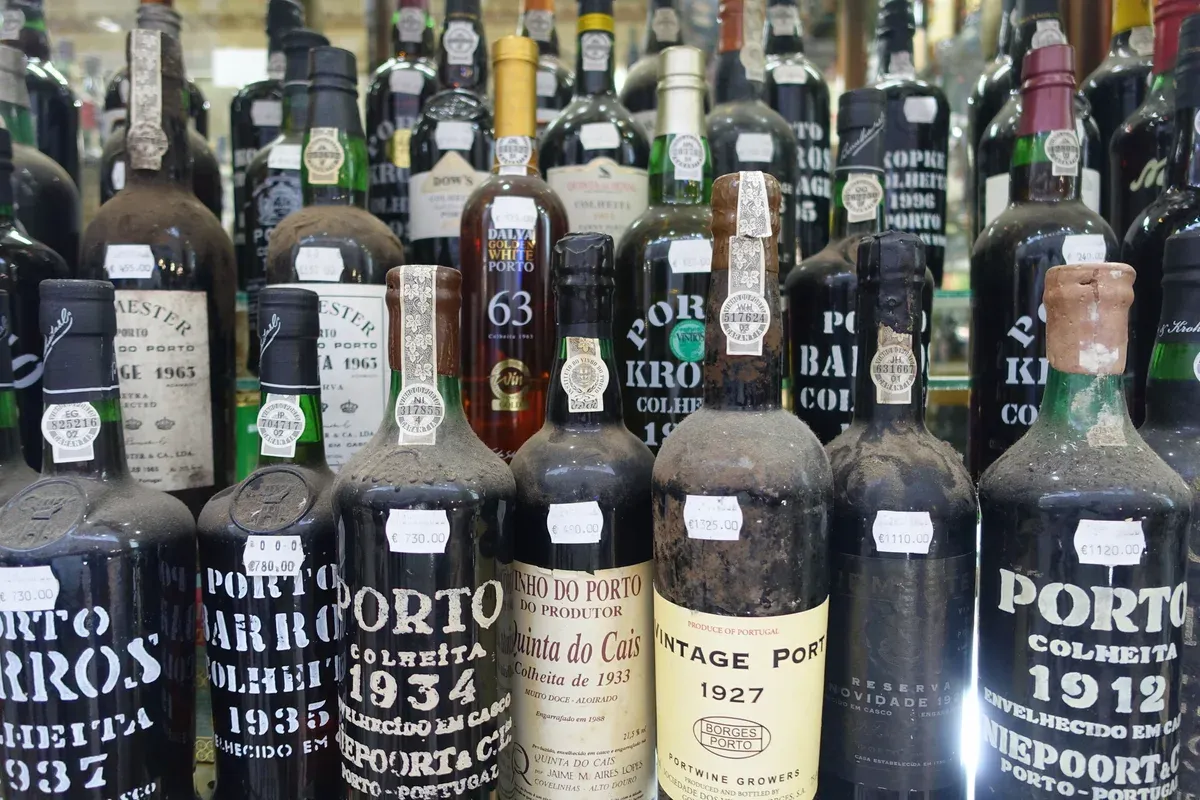
Bottles of colheita and vintage port on a shop shelf. Photo: Daderot, CC0, via Wikimedia Commons
Quick answer Port types at a glance
Port is a fortified wine from the Demarcated Region of the Douro in Portugal, usually 19-22% vol, and the regulator IVDP sorts it into four families: Ruby, Tawny, White and Rosé. Each family holds several styles, from simple Ruby aged two or three years to 40 Year Old tawnies and bottle-aged Vintage. You can taste many of them in the cellars of Vila Nova de Gaia.
Key takeaways
- The four families and every style inside them are set out in The Four Families of Port.
- Ruby styles from two-year Ruby to Vintage are explained below, with LBV in depth on the LBV port page.
- Aged tawnies and Colheitas get their own page on tawny port.
- To taste several types in one outing, the Small-Group Port Cellars Tour pours 7 ports across 3 producers for $61.78, and the Poças Port Cellar Tour pours White, LBV and Reserve Tawny for $26.31.
What Port Is
Port is a fortified wine, and the details matter when you compare the types on a cellar list.
A Fortified Wine From the Douro
By the IVDP's own definition, Port is a fortified wine as defined in EU legislation, produced in the Demarcated Region of the Douro. The finished wine usually sits between 19 and 22% vol. That is stronger than normal table wine. A bottle of Light Dry White Port is the exception, with a minimum alcohol of 16.5%.
The Douro Demarcated Region covers about 250,000 hectares, of which vines cover about 18%. The region was demarcated on 10 September 1756 under the Marquis of Pombal, one of the earliest formal wine demarcations anywhere. It splits into three sub-regions: Baixo Corgo with 13,204 ha under vine, Cima Corgo with 20,427 ha, and Douro Superior with 10,177 ha. About 20,000 farmers work it, with an average holding of just 2 hectares.
How Fortification Works
Port gets its strength and its sweetness from the same step. Fermentation is interrupted by adding neutral grape spirit, which Taylor's gives as brandy at 77% alcohol. Fortification happens when roughly half the natural grape sugar has turned to alcohol. The most frequent proportion is one part spirit to four parts of must-wine, and the resulting wine keeps its residual sweetness at 19-22% vol.
The winemaker sets the sweetness by choosing when to interrupt fermentation. The IVDP sweetness scale runs from extra dry under 40 g/l of sugar, through dry at 40-65 g/l and semi-dry at 65-90 g/l, to sweet at 90-130 g/l and very sweet over 130 g/l. All grape spirit used for port must be approved by the IVDP.
The Grapes and the Regulator
About 30 grape varieties are used to make port, though most modern vineyards plant five or six top reds. Taylor's lists Touriga Franca, the most widely planted variety in the Douro, plus Touriga Nacional, Tinta Roriz, Tinta Barroca, Tinta Amarela and Tinto Cão. Touriga Nacional has small thick-skinned berries and low yields and gives dark, concentrated, tannic wines.
The IVDP, the Instituto dos Vinhos do Douro e do Porto, classifies and certifies the wine. In spring after each harvest a first selection and blending is made and every lot is classified by its potential. The regulator even grades the styles: Vintage is graded 9 as exceptional, LBV, Crusted, Colheita and age-indicated tawnies are graded 8, and the Reserve styles are graded 7.
Why the Wine Ages in Gaia
After the harvest the wine stays at the Douro winery until spring, then moves downriver. The IVDP says wines age either in the Douro or downriver in the Vila Nova de Gaia bonded lodges, which is exactly the row of cellars you can visit today. Rabelo boats, flat-bottomed wooden cargo boats, carried the barrels down the Douro to Gaia, and the port companies still keep rabelos on the river, with a race held on 24 June for São João.
Cask ageing loses wine to evaporation. Taylor's puts the angel's share at as much as 2% in the first years, which concentrates sugars, acids and aromas. That slow concentration in wood is what separates the tawny styles from the ruby styles. For how long each bottle keeps after opening and at what temperature to serve each type, see how to drink port wine.
The Four Families of Port
The IVDP groups all port into four families, and every style you will meet on a Gaia tasting list sits inside one of them. The table maps the families to their styles and to where each one ages, in wood or in bottle, which is the single most useful distinction for a taster.
One Table for Every Style
Ruby styles age mostly in large vats or bottles and keep their deep fruit colour. Tawny styles age long in smaller oak and turn gold-brown. White port is made from white grapes and rosé from lightly macerated red grapes.
Colour runs from deep red to light gold across the whole range, with white ports in pale yellow, straw and golden white. Note that rosé, although made from red grapes, is a family of its own in the IVDP scheme while it sits under the ruby-style categories for ageing.
| Family | Styles | Ages in |
|---|---|---|
| Ruby | Ruby, Reserve, Crusted, LBV, Vintage, Single Quinta Vintage | Large vats or bottle, two to three years in wood for basic Ruby |
| Tawny | Tawny, Reserve, 10/20/30/40 years, Colheita | Oak casks, from Reserve up to 40 or more years |
| White | Extra dry to very sweet, Lágrima, Reserve, age-indicated, White Colheita | Large vats for young styles, wood about seven years for Reserve |
| Rosé | Rosé | Drunk young and chilled |
Sources: IVDP
Introduction to Port Wines
The main port styles explained one by one, from ruby to tawny and white. Third-party video by No Sediment. This site did not shoot it and has no relationship with the creator.
Ruby, Reserve, LBV and Vintage
The ruby family is where most first-time tasters start. All these styles share cherry, blackberry and blackcurrant fruit, and the differences are ageing and price.
Ruby
Ruby is the entry style of the family. Taylor's has the wine aged in vat for two or three years, and Wines of Portugal puts Ruby at up to 3 years in wooden barrels. The short, large-vessel ageing keeps the deep ruby colour and the fresh red fruit. It is undemanding: no decanting, and it keeps 8-10 days open by the IVDP guide.
The Poças tour pours three ports, White, Late Bottled Vintage and Reserve Tawny, so it is not the stop for a plain Ruby. The listings for the Burmester Cellar Tour and the Cálem Cellar Tour with Fado do not name the styles poured, so check with the cellar if a plain Ruby matters to you.
Reserve Ruby
Reserve Ruby is the next step up. The IVDP describes it as full-bodied, rich and deep ruby, and frequently a selection of the best port made each year. Taylor's notes that Reserve Ports age slightly longer than the two or three years of a plain Ruby. The IVDP grades Reserve Ruby at 7, very good, on its sensory scale.
If you want to compare Reserve against the tawny side, the Poças flight of three ports includes a Reserve Tawny for $26.31.
Crusted
Crusted is the odd one out. The IVDP defines it as a blend of wines of intense colour and full body, kept in bottle at least three years before sale, and it throws a deposit in bottle called the crust. Taylor's adds that Crusted is not from a single vintage and is not filtered before bottling. Wines of Portugal has it spending 3-4 years in wood before bottling, so it combines wood ageing with long bottle ageing.
It is graded 8, high, the same tier as LBV and Colheita. None of the tour listings names a Crusted, so ask the cellar if you want to taste one.
LBV, Late Bottled Vintage
LBV is a single-year ruby port bottled after four to six years in wood, against about two years for a Vintage. The IVDP says most LBVs are ready to drink on purchase, while some keep ageing in bottle. Wines of Portugal fixes the bottling window between 31 July of year four and 31 December of year six, with bottle-matured LBV spending at least three years in bottle. The IVDP grades LBV at 8, high.
The style was first launched in 1970 as an affordable, ready-to-drink alternative to Vintage, and it is now one in five port purchases in the UK. Opened, the IVDP gives it 4-5 days, while Taylor's says it lasts several weeks by the glass. Unfiltered bottlings, like the Fonseca and Ramos Pinto 2013 at 19.3% vol and 95 g/l residual sugar, benefit from decanting. Because LBV has its own rules, history and serving notes, the full detail is on the LBV port page.
Vintage and Single Quinta Vintage
Vintage is the top of the ruby family and of port generally. The IVDP says it comes from a single year's harvest, is bottled two to three years after the vintage, and develops over 10 to 50 years in bottle. Young it shows intense ruby colour with red fruits and wild berries, and with maturity it takes garnet tones. Houses declare Vintage only in outstanding years: Taylor's lists 2024, 2018, 2017, 2016 and 2011 among its declared years, and historically only about three Vintage years are declared per decade. The IVDP grades Vintage at 9, exceptional.
A related style is Single Quinta Vintage, a single harvest from a single quinta. Opened Vintage is fragile: the IVDP gives it 1-2 days and Sandeman 2-3 days, so open it for a dinner, not a month of glasses. Serve at 16-18 C and decant. To taste vintage ports and tawnies side by side in Gaia, the Graham's Vintage Room Tasting pours vintage ports and tawnies in a library-style room, 2 hours for $78 with the group limited to 10 guests.
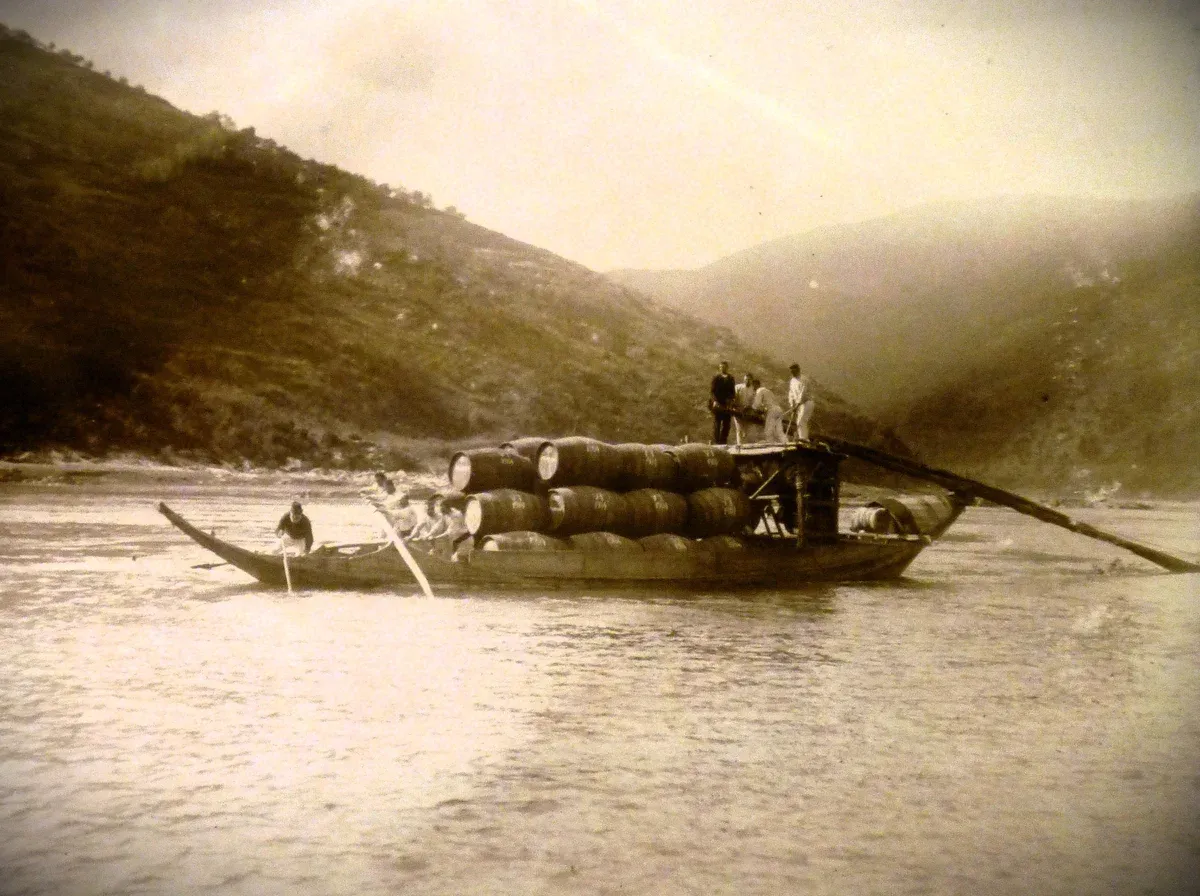
An old photograph of a rabelo boat carrying port barrels on the Douro. Photo: Bingar1234, CC BY-SA 4.0, via Wikimedia Commons
Tawny, Aged Tawny and Colheita
Tawny is the second great red family. These wines age in oak cask, lose their deep red colour and gain nutty, dried fruit flavours. The deep dive lives in the guide to tawny port.
Tawny and Tawny Reserve
Reserve Tawny is the step above basic tawny, and the IVDP lists it as aged in oak. On the IVDP sensory scale, Reserve Ruby, Reserve Tawny and Reserve White are graded 7 (very good), one step below the grade 8 of Colheita and age-indicated tawnies. An opened Reserve Tawny keeps three to four weeks per the IVDP.
For serving temperatures, see how to drink port wine.
Aged Tawny: 10, 20, 30 and 40 Years
Age-indicated tawny comes in 10, 20, 30 and 40 year old versions. The number is not one wine's age. Sandeman explains these tawnies blend several harvests and the stated age is the approximate average of the blend. A Cálem 10 Year Old is aged an average of 10 years in oak, and the same wording applies up the range. Sandeman's 30 Year Old is a strict selection of wines between 25 and 40 years of age at 20% alcohol. Graham's 40 Year Old is aged an average of 40 years in seasoned oak, and Quinta do Noval ages its 40 Year Old in 640-litre casks called cascos. Taylor's sells all four ages in one box, its Century Collection, with 100 years of combined ageing. These wines are graded 8 (high) on the IVDP scale, and the IVDP gives an opened bottle one to four months. Taylor's suggests serving a 40 Year Old slightly chilled at 12-16 C with no decanting.
See Graham's Vintage Room tasting, where vintage ports and tawnies are poured, priced at $78 for a 2 hour visit.
Colheita
A Colheita is the tawny answer to a single year. The IVDP defines it as single-vintage tawny aged in cask for a minimum of seven years. Dow's ages its Colheitas like blended tawnies in seasoned oak casks, but from one single harvest.
Quinta do Noval's Colheita 2012 spent about 15 years in wood before bottling. Colheita is graded 8 (high) on the IVDP scale, alongside LBV and age-indicated tawny. Dow's suggests tasting its 1996 Colheita slightly chilled and notes it keeps for some weeks after opening.
Cálem states its own Colheitas are aged a minimum of 10 years, a house policy above the legal floor of seven. More on this style in the tawny port guide.
Sources: IVDP
White and Rosé Port
Not all Port is red. White Port is made from white grapes and comes in six sweetness styles, while rosé is drunk young and chilled.
White Port, from Extra Dry to Lágrima
The IVDP sells white Port in six styles: extra dry, dry, semi-sweet, sweet, very sweet and Lágrima. Its sweetness scale runs by sugar in grams per litre: extra dry under 40, dry 40-65, semi-dry 65-90, sweet 90-130 and very sweet over 130. The winemaker sets the sweetness by choosing when to interrupt fermentation, and extra dry, dry and semi-sweet whites are fermented longer to cut residual sugar.
Younger whites are drunk as aperitifs and longer-aged ones after meals. White Port is served at 6-10 C and a modern-style white keeps 8-10 days opened, while a traditional white keeps 15-20 days. Light Dry White Port has a minimum alcohol of 16.5%, below the usual 19-22% range.
Reserve and Aged White Port
White Port also has serious aged categories. The IVDP lists White Reserve, White with age indication in 10, 20, 30 and 40 years, and White Colheita among its special categories. White Reserve is aged in wood for about seven years, and Wines of Portugal states a minimum of seven years.
Aged white Ports develop golden hues similar to old tawnies. An opened white with age indication keeps one to four months, the longest of any white style. Taylor's notes ordinary white Port is usually aged two or three years in large vats, and that its Chip Dry, first launched in 1934, was the first dry white Port.
Rosé Port
Rosé Port sits inside the ruby family on the IVDP grouping: it is made from lightly macerated red grapes, giving a pink wine with fresh red fruit. It is drunk young, chilled or with ice, and the IVDP gives a serving temperature of 4 C. Croft Pink, from the Croft house, is described as the first rosé Port, a light fresh fruity style served very chilled or in cocktails. Wikipedia credits the introduction of rosé Port to Poças and Croft.
No rosé is named in the Poças listing. The Poças guided visit and tasting at $26.31 includes three ports, White, Late Bottled Vintage and Reserve Tawny, in a 1.5 hour visit.
Sources: IVDP
How Port Is Made, in Short
Every type of port wine starts the same way, in the Douro. What differs is the grape, the moment of fortification and where the wine spends its years.
The Grapes and the Harvest
About 30 grape varieties can be used to make Port, though most modern vineyards plant five or six top reds. Taylor's lists Touriga Franca, Touriga Nacional, Tinta Roriz, Tinta Barroca, Tinta Amarela and Tinto Cão. Touriga Franca is the most widely planted variety in the Douro Valley.
Touriga Nacional has small thick-skinned berries and low yields and gives dark, concentrated, tannic wines. Tinta Barroca gives soft, round, fragrant wines. Tinto Cão, one of the oldest Douro varieties, is the least planted because of very low yields.
Harvest begins each year between the end of August and mid-October. Red Ports are made from riper grapes with high sugar, tannin and colour, while white grapes are picked earlier to keep aroma and acidity.
Fortification
Fermentation turns grape sugar into alcohol. When roughly half the natural sugar has turned to alcohol, grape brandy at 77% alcohol is added, which stops fermentation and keeps the wine's natural sweetness. Taylor's gives a working ratio of about 115 litres of brandy to 435 litres of fermenting wine, though this can vary.
The IVDP's most frequent proportion is one part spirit to four parts must-wine. All grape spirit used for Port must be approved by the IVDP. After fortification the wine keeps residual sweetness and lands at 19-22% alcohol by volume.
Ageing, the Rabelos and Gaia
In spring after the harvest a first selection and blending is made and each wine is classified by its potential. Wines then age either in the Douro or downriver in the Vila Nova de Gaia bonded lodges, which is where nearly every cellar tour on this site takes place. In the first years of cask ageing evaporation, the angel's share, can reach 2%, concentrating sugars, acids and aromas.
Rabelo boats, flat-bottomed wooden cargo boats, carried the barrels down the Douro to Gaia, and port companies still keep rabelos on the river, with a rabelo race held on 24 June for São João.
The 1756 Demarcation
The Douro Demarcated Region was created on 10 September 1756 under the Marquis of Pombal, with the Companhia Geral da Agricultura das Vinhas do Alto Douro. The vineyards were marked with 335 stone pillars, the marcos pombalinos, and Taylor's dates the first comprehensive classification of Port vineyards to 1757. Taylor's calls it the first vineyard demarcation in the world, while Wikipedia ranks it third after Chianti in 1716 and Tokaj in 1730.
The region covers about 250,000 hectares with vines on about 18% of the land, farmed by about 20,000 growers with an average holding of 2 hectares.
Which Cellar Tours Pour Which Types
The fastest way to learn the types of port wine is to taste them side by side in a Gaia cellar. The table below lists the Port styles each bookable tour pours, with the entry price from the tour listings.
Tours by Style Poured
Single-cellar visits pour two or three ports, and only some listings name the styles. Walking tours across several cellars go wider, and the Graham's Vintage Room tasting is the one that puts vintage ports and tawnies front and centre. Prices are the tour entry prices in US dollars exactly as listed, and none of these tours includes hotel pickup.
For the full comparison of every visit, see the Porto wine cellar tours homepage.
| Tour | Types poured | Price |
|---|---|---|
| Cockburn's Port Lodge Tour and Tasting | 3 ports, pairing options include tawny | $34 |
| Port Wine Lodges Tour, 7 Tastings | 7 ports across 3 port houses | $64.07 |
| Taylor's Port Cellars and Tasting | 3 ports, self-guided visit | $28 |
| Port Wine Tour, 3 Cellars, 7 Tastings | 7 ports across 3 producers | $61.78 |
| Graham's Lodge Tour and Vintage Room Tasting | Vintage ports and tawnies | $78 |
| Poças Guided Visit and Tasting | White, Late Bottled Vintage and Reserve Tawny | $26.31 |
| Cálem Cellar Tour, Fado Show and Tasting | 2 ports with a fado concert | $31 |
| Porto History Walk with Port Cellar | 3 wines at a Port cellar | $38.90 |
| Burmester Cellar Tour with Tasting | 2 to 3 ports depending on option | $26 |
| Port and Wine Experience Museum | A red, a white and a Port | $22.88 |
| Real Companhia Velha Royal Oporto Tour | Selected Ports | $22 |
| Porto Walking Tour, Cellar and 6 Bridges Cruise | Port tasting at a traditional cellar | $62.92 |
Types of Port Wine: Questions
Is Port wine stronger than normal wine?
Yes. The IVDP puts Port at 19-22% alcohol by volume, because grape brandy is added during fermentation. Most table wines sit well below that. Light Dry White Port is the exception with a minimum of 16.5%. Try a tasting on the Small-Group Port Cellars Tour to compare styles.
What is the difference between the types of Port?
The IVDP groups Port into four families: ruby style (Ruby, Reserve, LBV, Vintage), tawny style (Tawny, Reserve, 10 to 40 year olds, Colheita), white and rosé. Ruby wines keep their deep colour and fruit, tawnies age in cask and turn nutty, whites come from white grapes. The guide to tawny port covers the tawny side in depth.
Which is better, tawny or ruby Port?
Neither is better, they are different styles. Ruby styles show cherry, blackberry and blackcurrant fruit and are graded up to 9 for Vintage, while age-indicated tawnies and Colheita sit at grade 8 for their cask-aged nuttiness. Serve ruby at 12-16 C and tawny at 10-14 C per the IVDP. More in the guide to tawny port.
What is Port wine in Portugal?
Port is a fortified wine from the Demarcated Region of the Douro, classified by the IVDP (Instituto dos Vinhos do Douro e do Porto). It is made by stopping fermentation with grape brandy, leaving sweetness and 19-22% alcohol. The wine ages in the Douro or in the Vila Nova de Gaia lodges, where the Taylor's Port Cellars Tour visits a working cellar.
How many types of Port wine are there?
Four families with many styles inside them: ruby style covers Ruby, Reserve, LBV, Vintage and Crusted, tawny style covers Tawny, Reserve, 10, 20, 30 and 40 year olds and Colheita, white comes in six sweetness levels plus aged categories, and rosé completes the list. Taste three families at once on the Poças guided visit and tasting for $26.31.
What is Lágrima Port?
Lágrima is the sweetest white Port style on the IVDP list of six white styles, above very sweet. The name means tear. White Port is served at 6-10 C, and opened modern-style white keeps 8-10 days per the IVDP. Serving tips are in the guide to how to drink port wine.