 Porto Wine Cellar Tours
LBV Port: What Late Bottled Vintage Means and How It Differs From Vintage
LBV port is the single-year Ruby style that spends four to six years in wood before bottling, which makes it ready to drink on purchase. Vintage port follows the opposite path: two to three years in wood, then decades in bottle. This guide sets the two side by side using figures from the IVDP, Wines of Portugal and the port houses themselves, explains who declares a vintage, covers decanting and how long each style keeps once the bottle is open, and lists the port wine cellar tours in Vila Nova de Gaia and which one names an LBV in its tasting.
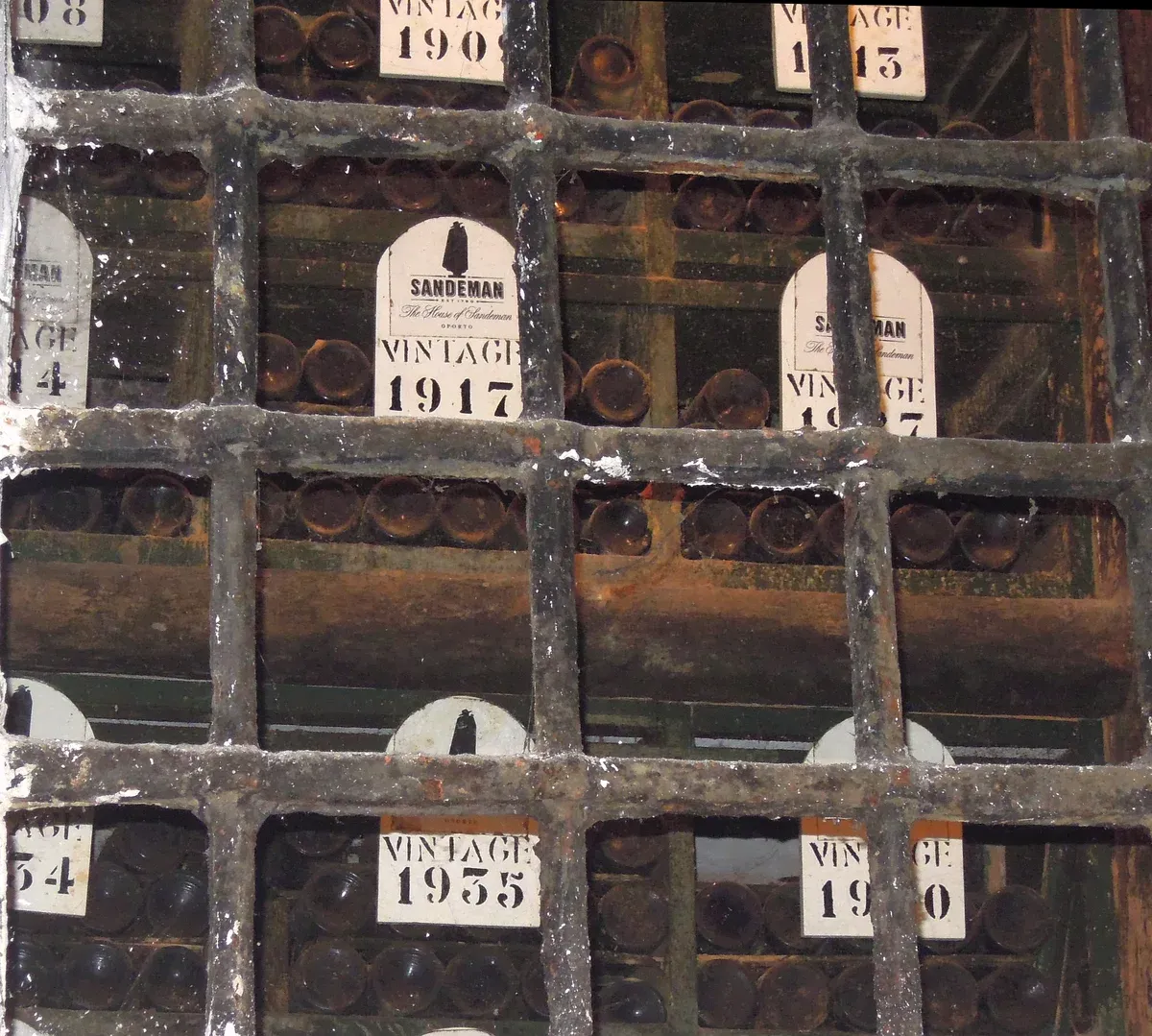
Old vintage port bottles behind a grille in a Porto cellar. Photo: Güldem Üstün from Istanbul, TURKEY, CC BY 2.0, via Wikimedia Commons
Quick answer LBV in brief
LBV port, short for Late Bottled Vintage, is a single-year Ruby Port aged four to six years in wood before bottling, so it is usually ready to drink when you buy it. Vintage port is bottled two to three years after the harvest and then ages in bottle for 10 to 50 years. That one difference changes decanting and how long the bottle keeps once open.
Key takeaways
- LBV mostly needs no decanting and keeps 4-5 days once open per the IVDP (Taylor's says several weeks by the glass), while opened vintage port keeps only 1-2 days per the IVDP. See the full comparison.
- Houses declare a vintage only in outstanding years, about three per decade according to Taylor's. Details under who declares a vintage.
- The Poças cellar tour names a Late Bottled Vintage in its three-port tasting, at $26.31.
- For the other families of port, see types of port wine, and for tawnies see tawny port.
What Late Bottled Vintage Means
The name describes the production method exactly: the wine comes from one vintage year, but it is bottled late.
The Definition
The IVDP, the institute that regulates port, defines LBV as a single-year Ruby Port bottled after four to six years in wood. Most LBVs are ready to drink on purchase, though some continue ageing in bottle. Wines of Portugal fixes the bottling window precisely: LBV is bottled between 31 July of year four and 31 December of year six after the harvest. A bottle-matured LBV must spend at least three years in bottle before release, a rule introduced after the IVDP banned the older term 'vintage character' in 2002.
Like all port, it is a fortified wine from the Demarcated Region of the Douro, normally 19-22% vol. Grape spirit is added during fermentation, in the most frequent proportion of one part spirit to four parts of must-wine, which stops the fermentation and leaves residual sweetness.
If you want the whole picture of how LBV fits alongside tawny, white and rosé, the page on types of port wine covers every category.
Where the Style Came From
Taylor's credits itself with launching the style. According to the Taylor's listing, LBV first appeared in 1970, when the house released an LBV from the 1965 harvest as an affordable, ready-to-drink alternative to vintage port. The idea was to give drinkers the character of a single year without the long cellar patience a declared vintage demands.
The style caught on. Taylor's states that LBV now accounts for one in five port purchases in the United Kingdom and over a quarter of the port drunk in Canada, and that Taylor's itself holds 34% of LBV sales by value. That credit comes from Taylor's own account.
An example of the style in practice: Ramos Pinto's LBV 2013 is a traditional unfiltered wine of 19.3% vol with 95 g/l of residual sugar, a blend of 50% Touriga Francesa, 36% Touriga Nacional, 5% Sousão and 9% old mixed vineyards, aged in vats of nearly 15,000 litres in Vila Nova de Gaia.
How It Sits Among the Ruby Styles
The IVDP groups port into Ruby style (Ruby, Reserve, LBV, Vintage), Tawny style, White and Rosé. LBV belongs to the Ruby family, which is why its fruit leans toward cherry, blackberry and blackcurrant, the flavours Taylor's lists for ruby styles. Plain Ruby ages usually up to three years in wood, Ruby Reserve is a richer selection of the best wine of each year, and Vintage is the top of the pyramid. Crusted Port is a related curiosity: a blend of full-bodied wines, not from a single vintage, bottled unfiltered and kept in bottle at least three years, forming a deposit called the crust.
What separates LBV from plain Ruby is the single year and the longer wood time of four to six years. What separates it from Vintage is where it ages: in wood rather than in bottle.
Sources: IVDP, Port wine categories
LBV Against Vintage Port
Both styles come from a single harvest year. Everything after that diverges, and the table below lines up the figures from the IVDP, Wines of Portugal, Taylor's and Sandeman so you can see the gap at a glance.
The Core Differences
The table compares the two styles on the points buyers ask about most: time in wood, time in bottle, decanting and how long an opened bottle keeps. The ageing figures come from the IVDP's special categories page and its choose-and-enjoy guide. Keeping times differ between sources, and where houses disagree with the regulator both figures are given, because the honest answer is a range.
Taylor's sums up its own position plainly: LBV matures 4-6 years in wood against about two years for vintage, is ready on bottling and needs no decanting. Vintage port, by contrast, develops over 10 to 50 years in bottle.
| Feature | LBV | Vintage |
|---|---|---|
| Single year | Yes | Yes |
| Ages in | Wood, 4-6 years | Bottle, 10-50 years |
| Bottled after | 31 July of year four to 31 December of year six | Two to three years after the harvest (between 1 July of year two and 31 December of year three) |
| Decant | Not needed per Taylor's, though unfiltered LBVs such as Fonseca's benefit from it | Yes, IVDP and Sandeman both recommend decanting |
| Once open | IVDP: 4-5 days. Taylor's: by the glass for several weeks. Fonseca unfiltered: optimum two months | IVDP: 1-2 days. Sandeman: 2-3 days |
| Serve at | Ruby style 12-16 C per IVDP, Fonseca LBV sheet says 16-18 C | 16-18 C per Sandeman |
| Ready to drink | Mostly on purchase | Can be drunk young but improves for decades |
Who Declares a Vintage
No rule forces a house to bottle a vintage port every year. Each shipper decides, and Taylor's describes the process: the declaration decision is made in the spring of the second year after the harvest, after the wines have spent two winters in oak vats. Taylor's announces its decision on Saint George's Day, 23 April. A declared blend must be of outstanding quality, austere in youth, with great depth and structure.
Historically only about three vintage years are declared per decade, Taylor's states. Its own declared years on record include 2017, 2016, 2011 and 2007 among recent ones, with the list reaching back to 1963. Sandeman names 2018 as a declared year and confirms the same two-to-three-year bottling window. When Symington declared 2017 for Graham's, Dow's, Warre's and Cockburn's, it was its first back-to-back general declaration since Andrew James Symington arrived in Porto in 1882, with yields about 20% below the ten-year average and the smallest Symington declaration of the century.
Which Should You Buy
For drinking this month, the case for LBV port wine is simple. Taylor's says its LBV is ready on bottling, needs no decanting and works by the glass for several weeks after opening. For laying down, vintage port wins: the IVDP gives it a development window of 10 to 50 years in bottle, and a young vintage can be drunk now or kept for decades.
On availability, vintage port is declared only about three years per decade, according to Taylor's, and Taylor's describes its LBV as an affordable, ready-to-drink alternative.
On the question of whether Taylor's is cheap wine, no price tier is stated here. What is stated is that Taylor's holds 34% of LBV sales by value, which is a market share, not a price tag.
The Difference Between Vintage Port and LBV
How a Late Bottled Vintage differs from a vintage port in the cellar and in the glass. Third-party video by World of Port. This site did not shoot it and has no relationship with the creator.
Serving and Keeping LBV and Vintage
The regulator and the houses give slightly different numbers for temperature and keeping time. Here they are side by side.
Temperatures and Glasses
The IVDP serves Ruby style port, which covers LBV, at 12-16 C. House sheets run a little warmer: Fonseca gives 16-18 C for its unfiltered LBV, and Quinta do Noval gives 15-17 C for its own. For vintage port, Sandeman recommends 16-18 C, in large glasses, decanted. Sandeman also suggests glasses of at least 35 cl for port in general.
Serving technique in depth, including glass shapes and food matches, belongs to the guide on how to drink port wine. This page sticks to what changes between LBV and vintage.
Decanting
This is the practical dividing line. The IVDP recommends decanting older vintage port and serving it in large glasses. Sandeman says the same for vintage: decant, serve at 16-18 C. Ramos Pinto's vintage sheet goes further, advising that the bottle be opened two hours before serving and decanted, and stored on its side.
LBV mostly skips the ritual. Taylor's states its LBV is ready on bottling and needs no decanting. The exception is unfiltered LBV: Fonseca bottles without fining or filtration and says its wine benefits from decanting. So check the label. If it says unfiltered, decant. If not, open and pour.
How Long Each Keeps Open
Opened vintage port fades fast. The IVDP allows 1-2 days, Sandeman gives 2-3 days and advises storing the bottle lying down so the cork stays moist. An LBV keeps longer. The IVDP's figure is 4-5 days, but Taylor's claims several weeks by the glass and Fonseca's unfiltered sheet names two months as the optimum window after opening. All three figures are printed because the regulator and the houses genuinely disagree.
For context, ruby and ruby reserve keep 8-10 days per the IVDP, tawny and tawny reserve 3-4 weeks, and age-indicated tawnies 1-4 months. Storage in an unopened bottle follows the same split as serving: non-vintage bottles stand upright, vintage lies down, in a cool dark place, per Sandeman. Ramos Pinto gives 17-18 C for a stored vintage and its LBV stores upright at 14-18 C.
Cellar Tours That Pour an LBV
You can read about Late Bottled Vintage or taste one in Vila Nova de Gaia. These cellar visits are the ones on this site closest to the style, and the prices below are the card prices.
Where To Taste One
Only one listing on this site names an LBV among its pours. That is Poças, whose listing spells out a tasting of White, Late Bottled Vintage and Reserve Tawny for $26.31. At Taylor's, the house that says it launched the first LBV in 1970, the self-guided cellars visit costs $28 and finishes with three ports in the garden. Cockburn's and the CD Porto small-group walk also include tastings, though neither card says whether an LBV is among the ports.
No tour on this page offers hotel pickup. If you specifically want to taste vintage port, the Graham's Vintage Room tasting is the listing that names vintage ports in its glass line-up, at $78 for a two-hour visit limited to 10 guests.
All prices below are the card prices.
| Tour | LBV poured | Price |
|---|---|---|
| Cockburn's Port Lodge Tour | Not stated by name on the card | $34 |
| Taylor's Port Cellars Tour | Not stated by name | $28 |
| Poças Port Cellar Tour | Yes, named in the tasting line-up | $26.31 |
| Small-Group Port Cellars Tour | Not stated by name on the card | $61.78 |
What Each Visit Actually Covers
The Poças visit is a guided walk through a family-owned ageing cellar in 1.5 hours, for up to 20 people, and its sausages and cheeses are sold separately, not part of the ticket. Taylor's is self-guided with an audio guide in 13 languages, runs 2-3 hours, and asks you to bring headphones because the guide plays on your phone. Cockburn's is a guided 1.5-hour visit of the largest port lodge in Vila Nova de Gaia, with the cellars museum and the longest ageing gallery of any port cellar in the city, plus a three-port tasting with optional chocolate, tawny or cheese pairings. The CD Porto walk covers three producers within 400 m in 2.5 hours with 7 tastings, capped at 12 people, and it starts on the dot, so latecomers cannot join.
Every listing named here offers free cancellation 24 hours ahead. Meeting points are at the lodges themselves for Poças, Taylor's and Cockburn's, and in front of the tourism office for CD Porto.
LBV and Vintage Port: Questions
What does LBV stand for in Port?
LBV stands for Late Bottled Vintage. The IVDP defines it as a single-year Ruby Port bottled after four to six years in wood, with bottling allowed between 31 July of year four and 31 December of year six after the harvest. See what Late Bottled Vintage means.
Does LBV port wine contain alcohol?
Yes. Port is a fortified wine and the IVDP gives the usual strength as 19-22% vol, reached by adding grape spirit during fermentation at roughly one part spirit to four parts wine. Specific bottlings sit inside that band, such as the Ramos Pinto LBV 2013 at 19.3% vol. More on the definition.
Do you decant LBV port?
Usually no. Taylor's states its LBV is ready on bottling and needs no decanting. The exception is unfiltered LBV: Fonseca bottles without fining or filtration and says its wine benefits from decanting. Vintage port is the opposite, with the IVDP and Sandeman both recommending decanting. The split is set out under decanting.
How long does LBV keep once opened?
The sources disagree and all three are worth knowing. The IVDP allows 4-5 days, Taylor's says several weeks by the glass, and Fonseca's unfiltered sheet gives two months as the optimum window. Compare that with vintage port at 1-2 days per the IVDP. Full figures under keeping.
What is the best year for vintage Port?
Houses declare vintages only in outstanding years, about three per decade according to Taylor's, so there is no single best year. Taylor's declared list includes 2017, 2016, 2011 and 2007 among recent years, and Sandeman names 2018. The declaration process is explained under who declares a vintage.
Where can I taste an LBV in Porto?
In Vila Nova de Gaia, the Poças guided visit names Late Bottled Vintage in its three-port tasting for $26.31, and Taylor's cellars visit costs $28 with three ports, from the house that says it launched the first LBV. The line-up and prices are under tours that pour an LBV.